Garage Door Off Track: What Causes It and Why You Should Stop Using It
Why garage doors jump the track — worn rollers, snapped cables, impacts, loose brackets — the safety risk of forcing an off-track door, and how a pro realigns it.
By Bay Area Garage Door Service · May 20, 2026 · 6 min read
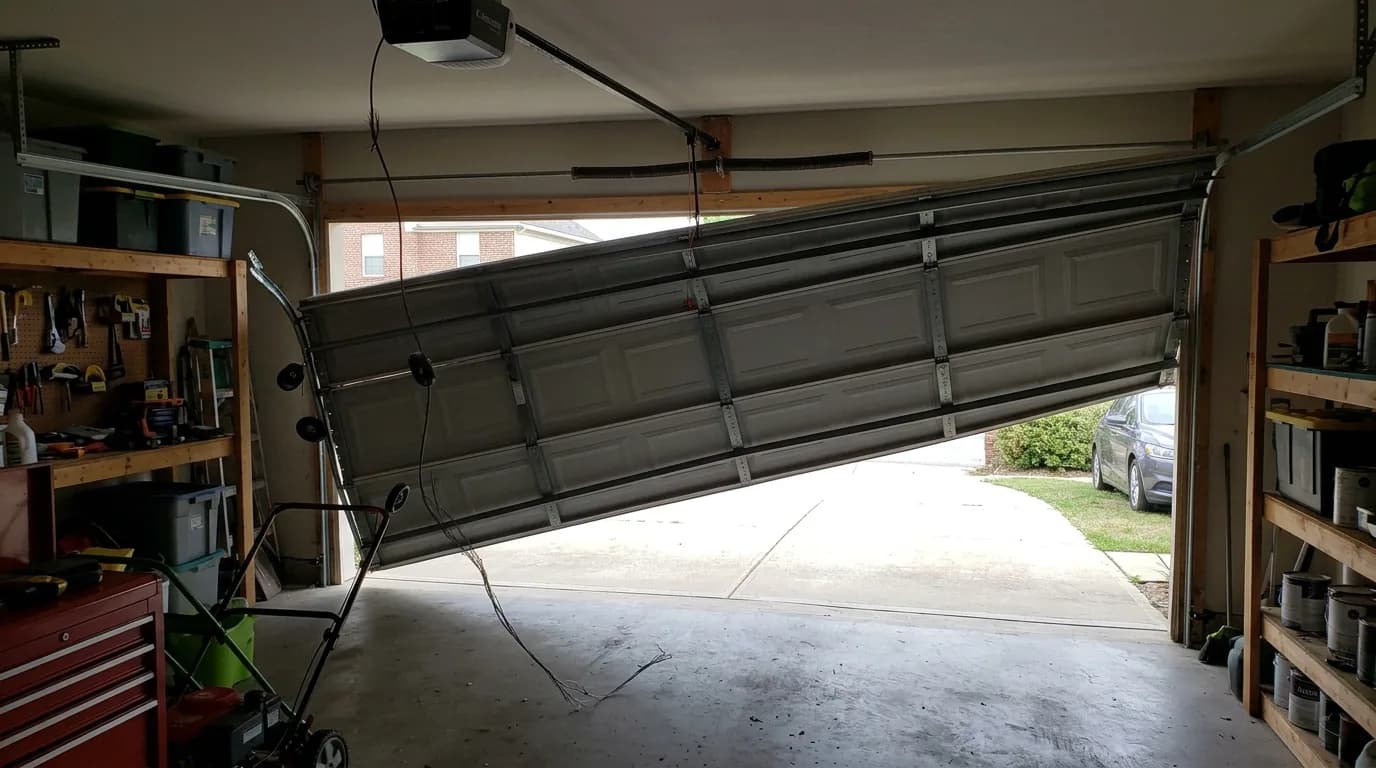
One morning the door goes up fine. The next, it's hanging at an angle, one corner sagging out of its channel, a roller dangling in mid-air where it should be riding the track. Maybe you heard a snap the night before, or maybe it just started binding and grinding until it finally jumped the rail. Whatever led up to it, an off-track garage door is not a "get to it this weekend" problem — it's a door that can fall, and the safest thing you can do is stop operating it. Here's what actually causes a door to leave its tracks, and why forcing it is a genuine hazard.
How is a garage door supposed to stay on its track?
Your door isn't bolted to the wall — it hangs in a carefully balanced system. Rollers on the edge of each panel ride inside steel tracks, curving from vertical at the opening to horizontal along the ceiling. Two lift cables, wound around drums on the spring shaft, carry the door's weight and keep both sides rising and falling together. The springs counterbalance the whole load so the door feels nearly weightless.
That balance is the key. As long as the cables are intact, the rollers are seated, and the tracks are true, the door glides. Knock any one of those out of tolerance and the door loses its guide — a roller pops free, one side drops, and the panel binds and levers itself out of the channel. Understanding the parts explains every common cause below.
It also explains why a derailment rarely happens out of nowhere. Most of the time the system was drifting out of tolerance for a while — a bearing getting rougher, a cable losing strands, a bracket backing off a quarter turn — until one cycle tipped it over the edge. The failure feels sudden, but the wear that caused it was gradual and, in almost every case, visible beforehand.
What actually knocks a garage door off its track?
In the field, off-track doors almost always trace back to one of a handful of causes:
- Worn or broken rollers. Cheap steel rollers with unsealed bearings wear egg-shaped or seize entirely, especially in humid coastal garages. A roller that can't turn drags instead of rolling and eventually climbs out of the track.
- A snapped or frayed lift cable. When one cable lets go, that side of the door loses its support instantly. The door drops on the failed side, goes crooked, and the rollers on that edge peel out of the channel. This is the single most common way a door ends up hanging at an angle.
- Impact. A car bumper, a bike handlebar, or a stray basketball hitting the door at the wrong spot can bend a track or shove a panel out of line in one shot.
- Loose track brackets. The brackets that fasten the tracks to the wall and ceiling work loose over thousands of cycles. A track that shifts even a little gives the rollers room to jump.
- An obstruction on the track. A tool left on the horizontal rail, hardened grease and grit, or a stone lodged in the channel can stop a roller cold and derail the door.
Notice how many of these are wear items that show warning signs first — a grinding roller, a fraying cable, a rattling bracket. That's exactly why we push a regular garage door maintenance tune-up: catching a worn roller or a corroding cable during a scheduled visit is far cheaper and safer than a derailment. Our guide to how often to service your garage door lays out a realistic cadence.
Why is it dangerous to keep using an off-track door?
It's tempting to hit the button one more time and hope it seats itself. Please don't. An off-track door is unstable in a way that stacks risk on top of risk:
- It can fall. A door that's already out of its guide and unevenly supported can come down suddenly and hard. These doors weigh hundreds of pounds and there is a car, and often people, underneath.
- The opener makes it worse. Running the motor against a bound door pulls the remaining rollers out, bends more track, and can snap the second cable — turning a one-panel fix into a whole-system repair.
- Stored spring energy is in play. If a cable failed, the springs are still under tension and the load is now unbalanced. That combination is unpredictable and is not something to test by hand.
If your door won't move for reasons you can't see, our technician's diagnostic checklist helps you tell an off-track problem apart from a dead opener or a broken spring — safely, without forcing anything.
What should I do the moment I notice it?
Keep it simple and keep your hands clear. Stop pressing any button, remote or wall. Pull the manual release cord to disconnect the opener so nobody can drive the motor against the jam. Then leave the door exactly where it is — don't try to muscle it up, down, or back into the track. If the door is partly open and you're worried about it dropping, keep people and cars out from under it and wait for a technician. Trying to lever a heavy, unbalanced door back onto its rail by hand is how people get hurt.
How does a professional get the door back on track?
This is precise, high-tension work, which is why it's a trained-technician job rather than a DIY one. When we arrive for an off-track and cable repair, the sequence looks like this:
- Secure and support the door first, and safely manage any spring tension before touching the tracks, so nothing drops or snaps during the work.
- Replace the failed hardware, not just the symptom — new cables installed in pairs, fresh sealed rollers, and any bent bracket, hinge, or track section straightened or swapped out.
- Re-rail and re-align the door onto true, plumb tracks with the correct spacing, so it travels centered without rubbing the frame.
- Re-balance and safety-test the whole system, cycling the door repeatedly to confirm smooth, level, quiet travel and checking that the spring balance and safety cables are right.
Because both cables share the same wear and cycle life, we replace them as a pair — leaving one old cable in place almost guarantees a repeat failure within months. The same goes for rollers on a door where the bearings have started to go.
When should I call, and how fast can it be fixed?
Call as soon as you see a crooked door, a dangling or frayed cable, a roller out of its channel, or a door that binds hard against the frame. These are all same-day, often emergency, repairs — and we don't charge a premium for evenings or weekends. Our trucks carry the common cables, rollers, and track hardware, so most off-track doors are back in service in a single visit. Every job starts with a free written estimate and a full-system safety check, so the fix addresses the root cause and the door doesn't jump the track again a week later. In the meantime, keep the opener disconnected and everyone clear of the door.