Garage Door Won't Open or Close? A Technician's Diagnostic Checklist
A step-by-step way to tell why your garage door won't open or close — dead remote, misaligned sensors, broken spring, off-track roller — and what's safe to check vs. call a pro.
By Bay Area Garage Door Service · June 2, 2026 · 7 min read
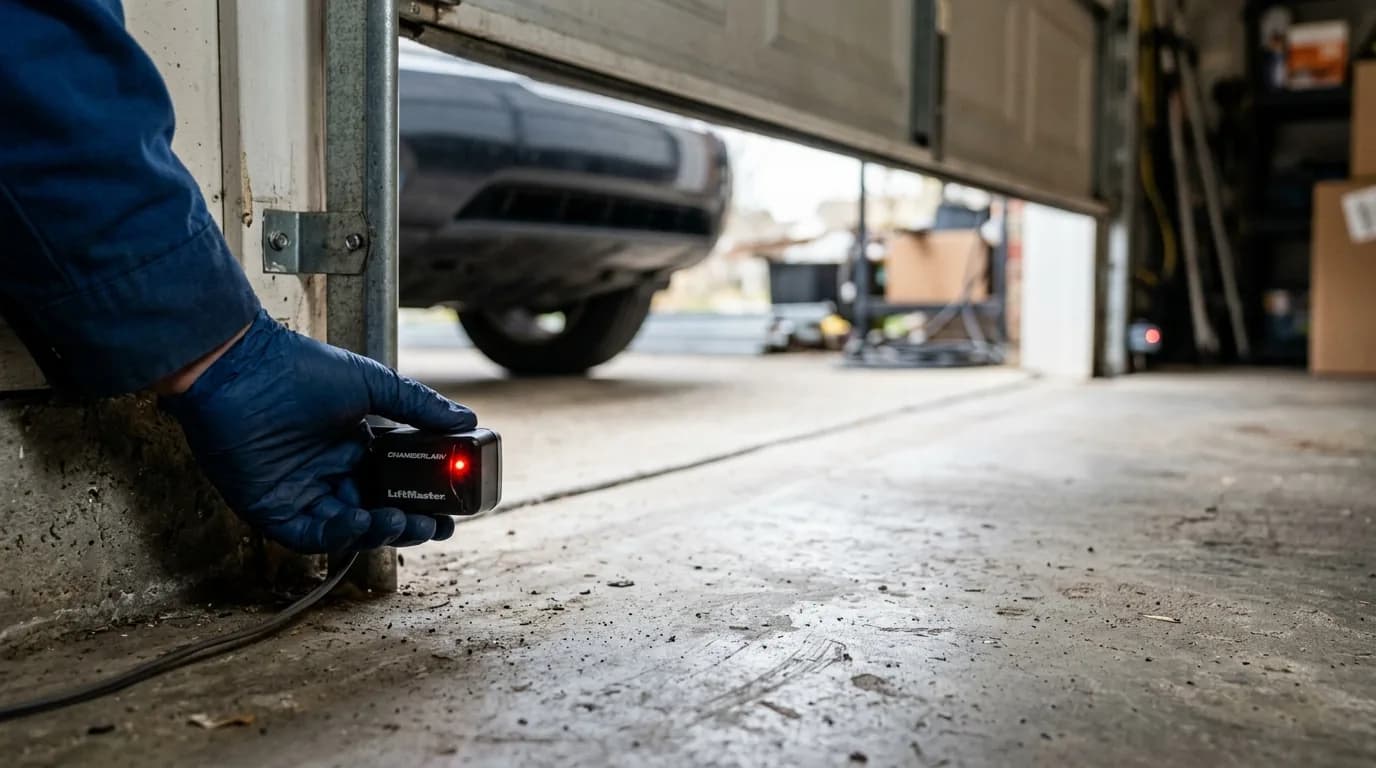
You're already running late, you press the button, and nothing happens. Or the door lurches up a foot and slams back down. Or it closes halfway, thinks better of it, and reverses. A garage door that won't cooperate is rarely random — it's telling you exactly which part has failed, if you know how to read the symptom. This checklist walks through the same order of elimination a technician runs through in the driveway, so you can narrow the cause and know which checks are safe to make yourself and which ones mean it's time to stop and call.
Work through it top to bottom. The safe, no-tools checks come first for a reason.
Is it the door, or is it the power and the remote?
Before you assume the worst, rule out the cheapest causes. A surprising number of "dead door" calls come down to something simple:
- Power. Confirm the opener is plugged in and the outlet is live — a tripped GFCI or a breaker knocked out by an unrelated appliance will silence the motor completely. Try the hardwired wall button, not just the remote.
- The remote. If the wall button works but the remote doesn't, it's almost always a dead coin-cell battery or a remote that needs re-pairing. Swap the battery first.
- The lock or vacation mode. Many wall consoles have a lock button that disables remotes entirely. It's easy to bump without noticing.
If the wall button and remote both do nothing and the power is confirmed good, the fault is in the opener or the door itself — keep going.
Does the motor run, but the door doesn't move?
This is one of the most telling symptoms. You hear the motor hum or the opener light flash, but the door stays put or barely twitches. That usually means the opener is fine — the problem is downstream, in the parts that carry the door's weight.
The most common culprit is a broken spring. Your door weighs 150 to 400 pounds, and the springs, not the motor, do the lifting. When a spring snaps, the opener is suddenly asked to hoist a quarter-ton dead weight it was never designed to move, so it strains, hums, and gives up. Look for a visible two-inch gap in the coil spring on the shaft above the door. If you see it, stop pressing the button — you'll burn out the motor. A snapped spring is the single most dangerous garage door repair to attempt yourself, which is why we cover the full story in why a broken spring is never a DIY job, and why the fix belongs to a certified garage door spring repair technician with the right winding bars and tension specs.
A motor that runs without moving the door can also mean a stripped drive gear or a disconnected trolley — both real opener faults. But because the spring is by far the most likely and most hazardous cause, that's the one to rule out first, and to rule out from a safe distance.
Does the door reverse before it closes?
If the door starts down and then immediately climbs back up, the opener is doing exactly what safety law requires — it's detecting an obstruction, real or phantom. The cause is almost always the photo-eye safety sensors, the two small units mounted a few inches off the floor on either side of the opening.
- Misalignment. A bumped bracket knocks the invisible beam out of line. Most sensors show a steady LED when aligned and a blinking or dark LED when they're not "seeing" each other.
- Obstruction. A trash can, a coiled hose, a cobweb, or even direct sunlight hitting the receiver lens can break or wash out the beam.
- Dirty lenses. Fog, dust, and spider silk are common in Bay Area garages and will fool the sensor into seeing an obstacle that isn't there.
Gently wiping the lenses and confirming both sensors point straight at each other resolves many of these. If the LEDs won't hold steady even after cleaning and nudging, the wiring or the sensor itself may be failing, which is a job for an opener repair visit. Never disable the sensors to force the door shut — they exist to keep a closing door from crushing a child, a pet, or a bumper.
Does the door bind, catch, or hang crooked?
If the door moves but grinds, jerks, or looks uneven as it travels, the trouble is mechanical — in the rollers, tracks, or cables rather than the electronics. A roller that has jumped its track, a frayed lift cable, or a bent track section will make the door bind partway and stall.
This matters because forcing a door that's mechanically bound makes everything worse fast: you can pull it further off track, snap the second cable, or bend hardware that was still good. If your door is hanging at an angle, dragging on one side, or you can see a cable dangling loose, do not run the opener again. An off-track door can fall. We break down every cause and the safety risk in our guide to what puts a garage door off track, and the fix is a same-day off-track and cable repair that re-rails the door and replaces the failed hardware in pairs.
What can I safely check myself, and where do I stop?
Here's the honest dividing line. The following are safe for any homeowner:
- Checking power, the outlet, the breaker, and the wall-lock button.
- Replacing a remote battery and re-pairing it.
- Wiping the photo-eye lenses and clearing anything blocking the beam.
- Pulling the manual release cord to see whether the door lifts smoothly by hand — if it's impossibly heavy or crashes down, the springs or cables are the problem.
Everything past that point — adjusting spring tension, replacing cables, re-railing a door, opening the opener's motor head, or resetting travel and force limits — involves high-tension components or electrical work that injures people every year. That's not a sales line; it's the reason the trade requires training. When your checklist lands on a spring, a cable, a track, or an internal opener fault, the safe and often faster move is to disconnect the opener and call a technician.
When should I stop troubleshooting and call a professional?
Call right away if you notice any of these: a loud bang before the door died, a visible gap in the spring coil, a door that's crooked or off its track, a dangling or frayed cable, or a door that feels like a dead weight when you lift it by hand. Those are load-bearing, high-tension failures, and continuing to press the button only compounds the damage and the risk.
Our technicians run this exact diagnostic on site, but with the tools and the parts on the truck to fix the root cause the same day — springs, cables, rollers, sensors, or the opener itself — not just the symptom. Every visit starts with a full-system safety check and a free written estimate, and we never bill evenings or weekends at a premium. If your door has stopped cooperating and the simple checks didn't solve it, disconnect the opener, leave the door where it is, and schedule a same-day garage door opener repair or full diagnostic.