Why a Broken Garage Door Spring Is a Repair You Should Never DIY
A snapped garage door spring stores enough energy to injure. Here's how torsion and extension springs work, why they fail, and why replacement is a certified-tech job.
By Bay Area Garage Door Service · June 18, 2026 · 6 min read
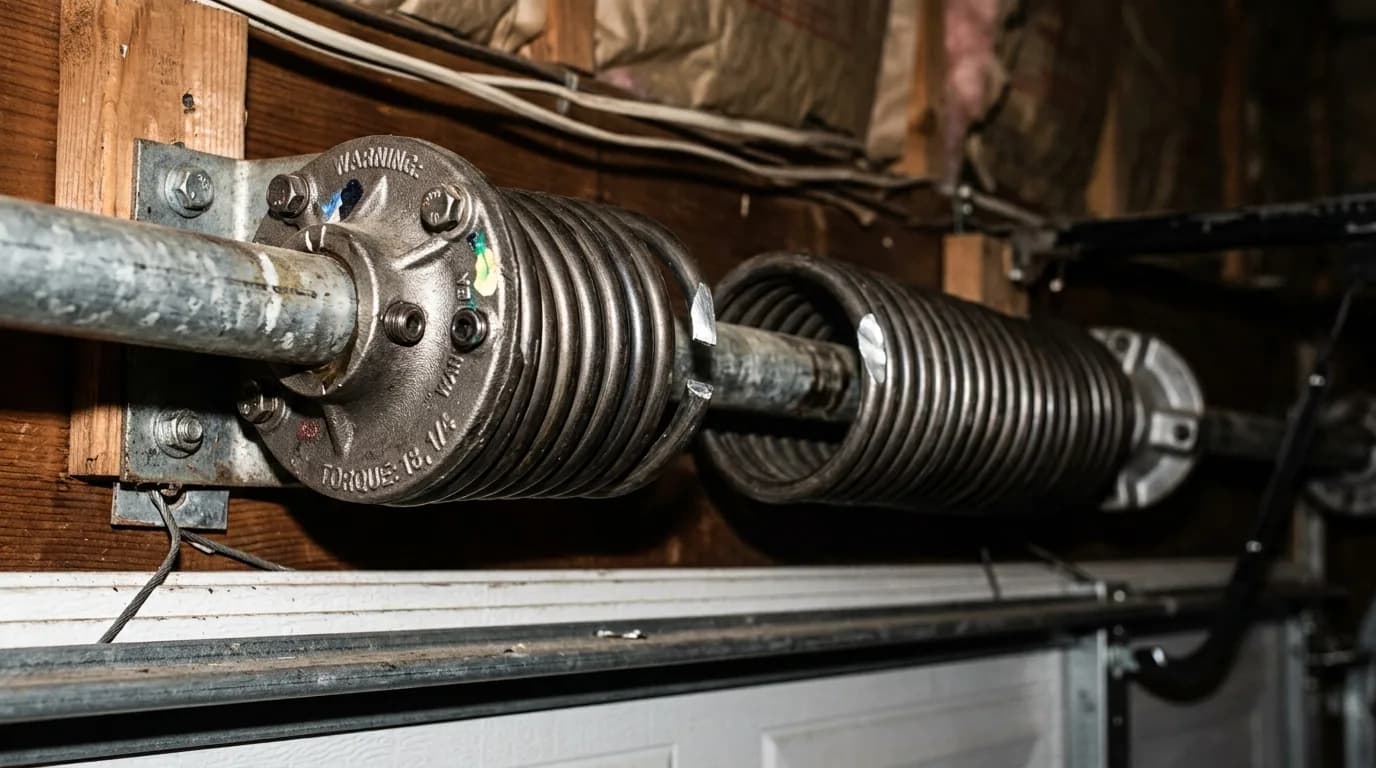
You heard it before you saw it: a bang like a firecracker from the garage, loud enough to make you think something fell. Then the next morning the door won't budge, or the opener strains, hums, and gives up. Nine times out of ten, that bang was a garage door spring snapping — and while it's one of the most common failures we see, it's also the one repair we most firmly urge you not to attempt yourself.
Here's why, and what's actually going on inside your door.
What does a garage door spring actually do?
Your garage door is heavy — a typical double door weighs between 150 and 250 pounds, and an insulated or custom wood door can exceed 400. The opener motor doesn't lift that weight on its own; it couldn't. The springs do. They counterbalance the door so it's effectively weightless in motion, and the motor just nudges it along.
There are two systems:
- Torsion springs mount on a metal shaft above the door opening. They store energy by twisting, and they're the more common, more durable, and higher-tension type — which is exactly what makes them dangerous to handle.
- Extension springs run parallel to the horizontal tracks on either side and stretch as the door closes. They should always be paired with a safety cable running through them, so that if one breaks it doesn't become a projectile.
Both types are wound or stretched to a precise tension matched to your door's exact weight and height. That stored energy is the whole point — and the whole hazard.
Why do garage door springs break?
Springs are rated in cycles — one cycle is one open and one close. A standard spring is rated for roughly 10,000 cycles, which sounds like a lot until you count real usage. A family that opens the door four to six times a day burns through 1,500–2,000 cycles a year, so 7 to 12 years is a normal lifespan. Homes that cycle the door constantly, or estates where staff and deliveries come and go, reach that limit far sooner.
Three things accelerate the end:
- Metal fatigue — every cycle flexes the steel a little; eventually it simply gives.
- Corrosion — in the Bay Area's coastal and foggy microclimates, salt air and humidity rust the coils and shorten their life. This is a big reason we recommend a garage door maintenance tune-up more often near the water.
- Poor balance and lubrication — a door that's out of balance or running dry works the springs harder than it should.
How do I know if my spring is the problem?
A few tell-tale signs point squarely at the spring rather than the opener or the tracks:
- You see a visible gap of about two inches in the coil of a torsion spring above the door.
- The door won't lift at all, or feels impossibly heavy when you pull the manual release and try to raise it by hand.
- The opener runs — you hear the motor — but the door doesn't move, or moves only a few inches and stops.
- The door came down fast and crooked the last time it closed.
If you're not sure whether it's the spring, the opener, or something else, our technician's diagnostic checklist for a door that won't open walks through how to tell them apart safely.
Why can't I just replace the spring myself?
This is the heart of it. A wound torsion spring holds an enormous amount of energy, and releasing or winding it requires the right winding bars, the correct technique, and steady control. If a bar slips — or if you use the wrong bar, a screwdriver, or a piece of rebar, as too many online videos suggest — the spring can unwind violently. The result is broken fingers, wrists, teeth, and worse. Emergency rooms see these injuries every year, and they are entirely preventable.
Beyond the raw danger, there's precision. Springs come in dozens of wire sizes, lengths, and inside diameters, and the wrong one won't balance your door — it'll burn out your opener, wear other parts prematurely, or leave the door dropping under its own weight. Getting a spring "close enough" isn't good enough on a component that holds a quarter-ton door in the air over your car and your family.
Our approach on a garage door spring replacement is straightforward: we measure the spring to your door, replace springs in pairs (more on that below), offer high-cycle upgrades where it makes sense, and re-balance and safety-test the whole door before we leave.
Should both springs be replaced if only one broke?
Yes — and this is worth understanding, not just accepting. On a two-spring door, both springs have taken the same number of cycles and aged in the same conditions. When one snaps, the other is statistically days or weeks from the same fate. Replacing only the broken one almost guarantees a second failure — and a second service call — in short order, and it leaves the door unbalanced in the meantime. Replacing the pair costs a little more today and saves the repeat visit.
What a professional spring repair looks like
When we arrive for a broken spring, the visit is quick because our trucks are stocked with a full range of spring sizes. We confirm the door's weight and the correct spring specs, safely release any remaining tension, install the new springs in a pair, re-check the cables and safety cables, wind to the exact tension, and then test that the door holds its position at mid-travel — the mark of a properly balanced door. The whole system, not just the spring, gets a safety check. Most broken-spring calls are same-day, and we never charge a premium for evenings or weekends.
If your spring has already snapped, don't keep pressing the opener button — you'll strain the motor and can pull the door off its tracks. Disconnect the opener with the manual release, leave the door down, and call for a same-day garage door repair.