Smart Garage Door Openers: Are LiftMaster & myQ Upgrades Worth It?
Wi-Fi garage door openers, myQ app control, and California SB-969 battery-backup rules — when a smart opener upgrade is worth it and when to repair the opener you have.
By Bay Area Garage Door Service · March 2, 2026 · 7 min read
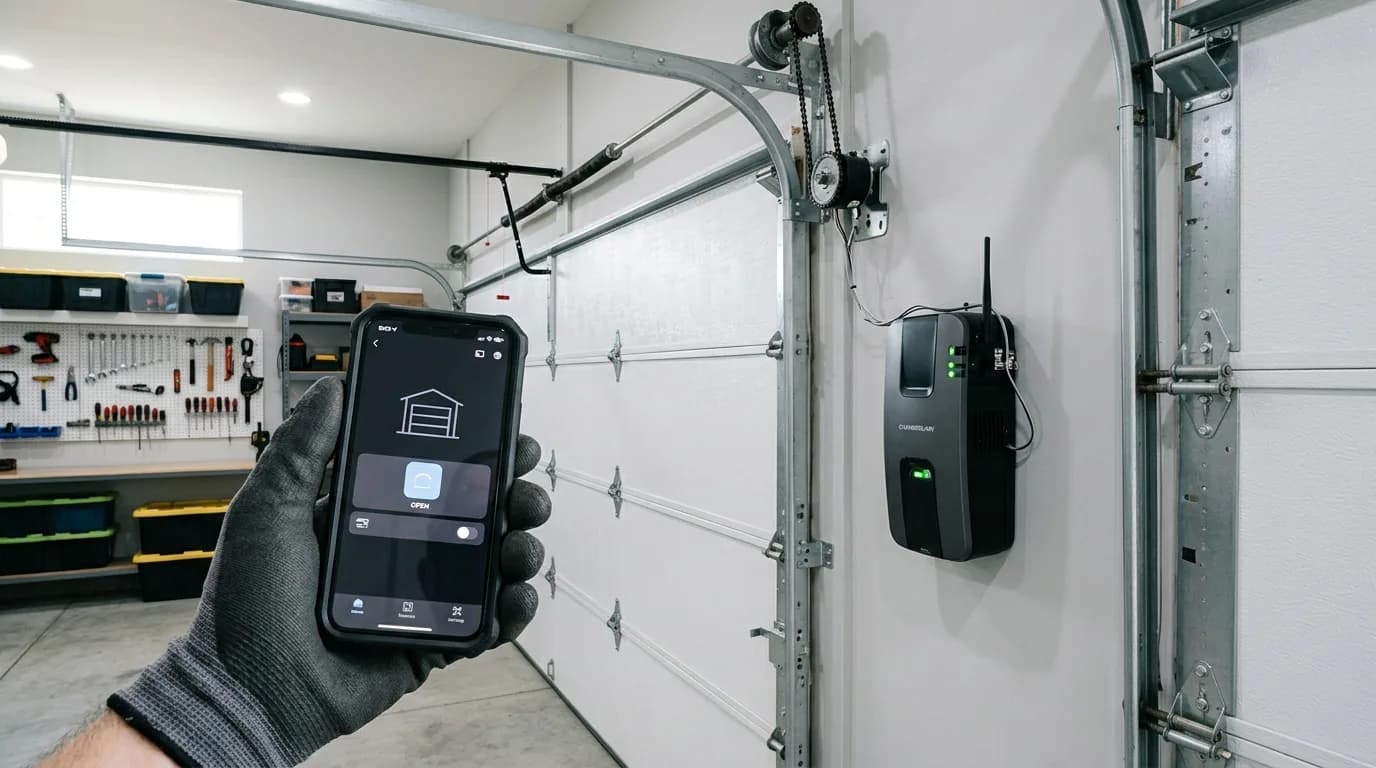
You are halfway to the airport when the question hits: did I close the garage? A generation ago that meant turning around. Today, a smart garage door opener lets you glance at your phone, see that the door is open, and close it from the freeway. That convenience is real — but a smart opener is a meaningful upgrade, and it is worth understanding what you actually get, what California law now requires, and when it makes more sense to simply repair the opener you already have.
What makes a garage door opener "smart"?
A smart opener is, at its core, a normal opener with a Wi-Fi radio and an app. The mechanical job is the same — drive the door up and down — but the connectivity adds a layer of awareness and control. The headline features are worth knowing by name:
- App control and status. Through an app like LiftMaster and Chamberlain's myQ, you can open or close the door from anywhere and, just as usefully, see whether it is currently open or closed.
- Alerts. The system can notify you when the door opens or closes, or nudge you if it has been left open past a set time — a genuinely useful safety net.
- Access sharing. You can grant temporary or scheduled access to family, a dog walker, or a delivery, and see a log of when the door was used.
- Automation and voice. Depending on the ecosystem, the door can tie into smart-home routines and voice assistants.
Underneath, a modern opener also brings rolling-code security, which changes the access code every time you use the remote so it cannot be captured and replayed — a real security improvement over older fixed-code units that broadcast the same code every time and could be recorded by a would-be intruder. The drive type matters too: belt-drive openers are noticeably quieter than chain-drive, which is worth it under a bedroom, while quiet wall-mount (jackshaft) units mount on the wall beside the door, free up ceiling space, and are excellent on heavy custom and glass doors.
It is worth separating the features you will genuinely use from the ones that sound impressive in a showroom. For most homeowners the everyday value is not voice control or elaborate automations — it is the simple peace of mind of glancing at the app to confirm the door is shut, and getting a nudge when it has been left open. Those two features alone change how it feels to leave the house.
Does California require battery backup on garage door openers?
Yes, and this is the single most important thing to know before you buy or replace an opener in California. Under California SB-969, residential garage door openers installed since mid-2019 are required to have a battery backup, so the door can still be opened during a power outage. The law grew directly out of wildfire evacuations, where people were trapped because a power failure left a heavy door they could not lift by hand and no safe way to get their car out.
For you, this means two things. First, any new opener we install is code-compliant with battery backup built in — that is not an optional upgrade, it is the standard. Second, if your current opener predates the rule and has no backup, that alone is a strong argument for replacement, especially in the Bay Area's fire-prone and outage-prone areas. When we handle a garage door opener repair or installation, a code-compliant battery backup is part of every new unit, so the door opens when the power does not.
Is a smart opener worth it, or should you repair what you have?
Not every opener needs replacing, and a good technician will tell you when a repair is the smarter money. The decision usually comes down to age, fault type, and what features you are missing.
Leaning toward repair when:
- The opener is under about ten years old and the fault is a specific part — a stripped drive gear, a bad logic board, a worn capacitor, or misaligned safety sensors.
- It already has rolling-code security and battery backup, so you are not missing anything on safety or code.
- You are happy with basic operation and do not want app control.
Leaning toward replacement when:
- The unit is older, noisy, and lacks battery backup or rolling-code security — you gain safety, code compliance, and smart features in one step.
- Repairs are stacking up on a motor that is near the end of its life.
- You genuinely want the app control, alerts, and access sharing, and a retrofit module will not deliver them reliably on your model.
One important caveat: many problems people blame on the opener are not the opener at all. A motor that hums and quits, or a door that reverses partway, is very often a spring, cable, or sensor issue overworking a perfectly good motor. Replacing a healthy opener will not fix a binding door or a failing spring — the new unit will simply struggle against the same underlying fault, and you will have spent money on the wrong part. Before you replace anything, it is worth ruling that out — our technician's checklist for a door that won't open walks through how to tell a motor problem from a door problem safely.
Can you make an existing opener smart without replacing it?
Often, yes — and it can be the best value of all. Many openers made in the last decade accept a retrofit smart module (a myQ or comparable add-on) that bolts app control and alerts onto the unit you already own, for a fraction of a full replacement. Whether it works depends on your opener's brand, model, and safety-sensor type, so it is worth having the model checked rather than buying a module and hoping.
If a retrofit is not compatible with your unit, that does not automatically mean you need a whole new opener on its own — but it is a natural moment to weigh a modern Wi-Fi opener that brings smart control, quieter operation, rolling-code security, and code-compliant battery backup together. This is also why, when homeowners plan a new garage door installation, we treat the opener as part of the package: a heavier new door needs an opener sized to its weight anyway, and pairing the two is the cleanest time to go smart. If you are weighing a new door at the same time, our guide to choosing a new garage door and material pairs naturally with this decision.
When should you call a professional?
Call for a proper assessment if your opener has no battery backup, if it is old enough to lack rolling-code security, if it is getting loud or intermittent, or if you simply want app control and are not sure whether a retrofit will work on your model. A technician can tell you in one visit whether the smart features you want are a quick module away or an argument for a new unit, and can confirm the whole system is safe — sensors aligned, force and travel set, and auto-reverse working. We will diagnose what you have, lay out repair-versus-replace honestly, and give you a free written estimate either way, with no charge for the diagnosis and no obligation to proceed.